ICF window cills, made for the block
Standard cills fail on ICF walls. Not because they are badly made. Because they are sized for the wrong wall.
An ICF cill has to cover the concrete core, the outer insulation, the render that has not gone on yet, and still throw water 40mm clear of the finished face. Get one number wrong and the drip lands on the render instead of past it. One small guess can cost more than you think.

Why standard cills come up short on ICF
Cill depth on ICF is not the block width. It is four numbers added together:
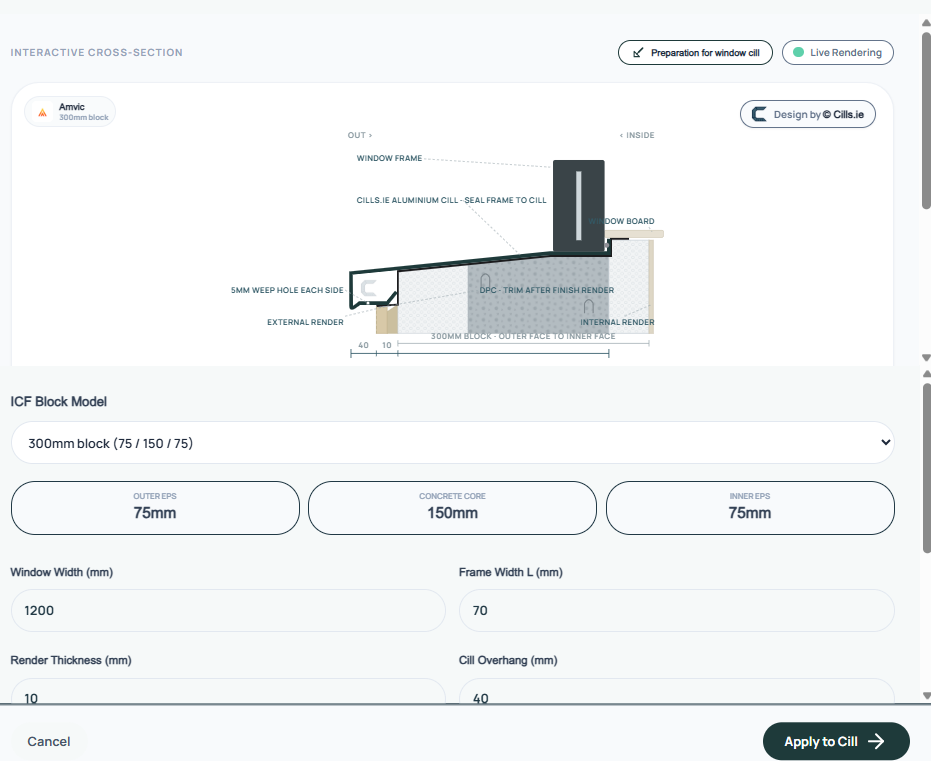
Take a common Irish block. 150mm core, 65mm outer foam, 10mm render, 40mm projection. That is a 265mm cill. Order off the block width and you are 15mm short the day the render goes on. The drip sits against the wall, water runs down the face, and the render at the base of every opening takes the hit.
Irish building warranty standards require the drip at least 40mm from the face of the rendered wall. Measured from the finished render. Not the bare block. A cill that passed on fit day can fail the day the renderers leave.
Aluminium does not forgive guessing. Neither does foam.
Watch the ICF Window Cill Fitting Guide
See the exact details, lapped upstands, preparation, and correct installation steps to ensure a completely weatherproof ICF window junction.
What is actually under the render?
Most ICF spec sheets show an EPS cill. Polystyrene, shaped to a fall, rendered over. That puts a few millimetres of render on foam on the most exposed horizontal surface of the whole house. One hairline crack and water sits on polystyrene with nowhere to go.
A Cills.ie ICF cill is one continuous folded sheet of 2mm powder coated aluminium. No joints on the weather side. The same junction as the certified detail, done in metal:
- A welded upstand behind the frame, sized so it never blocks the window's own drainage
- A flat landing carrying the frame on the concrete core
- A 7 degree fall over the outer insulation
- A front drop to the lowest tip, with a drip notch so water releases there and cannot crawl back along the underside
- A return landing flush on the basecoat, with weep holes so the pocket behind the drop drains by design
- A full DPC tray underneath, lapped up the jambs, trimmed flush to the finish render
Three lines of defence at the frame. A drained tray under the whole cill. A drip that clears the finished render. Not a sketch. Not an assumption. The real thing.
The leak nobody finds
ICF walls have a seam between the inside face of the foam and the concrete. Water that gets in anywhere, a head flashing, a jamb, a service hole, travels down that seam and exits at the lowest point. The sill.
So the cill collects water from the whole opening, sometimes the whole wall. That is why every Cills.ie ICF cill sits on a full DPC tray with a drainage path forward, and why a leak that shows at the cill usually started somewhere else.
We put the full picture in one free guide, the seven leak points at ICF openings and how to close every one.
Free Technical Guide
The 7 leak points at ICF openings. Gathered from building codes, lab testing and Irish sites.
Pick your block. The cill sizes itself.
The ICF Cill Depth Calculator holds every variant of the Irish ICF systems, the leaf splits, the cores, the overall widths, pulled from the certs and the manufacturers' technical sheets. Pick your system, pick your block, and the correct cill depth autofills with the full breakdown. Enter the window width and the cill length follows, wings included. Every order generates a spec sheet with the drawing reference for your block.
The calculator lives inside the Cills app. A free account takes a minute.
Create a free account and size my cillBuilt for the blocks Irish sites actually use
Every system page has the block variants, the worked cill depths and the calculator preselected for that manufacturer:
Amvic window cills
For 280 and 350 blocks
View System PageCastleforms window cills
All six ICF Therm variants including exterior extra foam
View System PageBuildBlock window cills
For 160 block, 150 and 200 core
View System PageThermoHouse window cills
Outer leaf changes based on U value options
View System PageNudura window cills
For Nudura block systems
View System PageWe make it. Your crew fits it. The prep decides everything.
ICF cills from Cills.ie are supplied made to measure, we do not fit them. Fitting is fast when the opening is prepared right, and impossible to get right when it is not. Once it is made it is made, so the preparation matters as much as the cill.
Our process supports you at every stage, from measuring, to manufacturing, and finally fitting.
Cut the seat
Core level where the frame lands, outer foam cut on the fall, seat wider than the ope so the cill wings drop into the reveals.
DPC tray
Over the full seat, lapped up both jambs. Not trimmed until the render is on.
Fit the cill
Bedded on the tray, upstand at the back, 7 degree fall, a basecoat sized gap under the front that the render will close. That gap is correct.
Fit the frame
On the landing, sealed to the cill. Window board closes the inside.
Built on the standards, corrected on site
Months of research sit behind this detail. NHBC render standards, the building code rules for sill flashing, the ICF industry's laboratory testing. Then ICF fitters on Irish sites picked at it, and their corrections are built in, the upstand height, the DPC route, the weep holes in the return. Every revision is dated on the drawing.
Manufacturer names are trademarks of their respective owners, used to identify compatible systems.
We Can Visit Your Site to Measure & Provide Samples
Need exact measurements on your ICF build? We visit active construction sites across Ireland to take opening dimensions, check reveal preparation, and provide physical aluminium colour and profile samples before folding in our Dublin workshop.

Site Survey & Measuring in Blessington
We visited this active ICF residential build in Blessington using the Castleforms block system. We measured every opening on site, verified the outer EPS leaf thickness and concrete core landing, and provided physical aluminium colour and profile samples before fabrication.

Site Survey & Measuring in Portlaoise
On-site measuring and sample handover for a live ICF project in Portlaoise built with 300mm Amvic blocks. We checked the window reveal setbacks, confirmed render allowances, and ensured the 40mm anti-capillary drip cleared the finished external wall face perfectly.
Book an On-Site ICF Measure & Sample Drop
Building with Amvic, Castleforms, BuildBlock, ThermoHouse, or Nudura? We visit your site in Dublin, Kildare, Laois, Wicklow, and nationwide to verify your openings and drop physical samples before folding.
Measure once. See the result. Order with confidence.
Made to measure aluminium ICF cills, supplied ready to fit. Welded upstands, end caps, weep holes, and the preparation guide and spec sheet with every order. Your crew fits it in minutes when the opening is prepared right, and the guide shows exactly how.
Size my cill, free account