
What Does "Breathable" Actually Mean?
Walk into any Irish retrofit site and you'll hear the word "breathable" at least five times before lunch. But strip away the jargon and it comes down to something simple: older walls were built to let moisture escape.
A stone cottage in Connemara. A Victorian terrace in Rathmines. A 1940s semi in Dundalk. These buildings don't have cavities or membranes. They were constructed with materials that allow water vapour to slowly pass through the wall and evaporate on the outside.
Lime mortar. Solid brick. Random rubble stone. These materials have tiny pores that act like billions of microscopic chimneys, carrying moisture from inside your home to the outside air.
Now imagine wrapping that wall in plastic. The moisture has nowhere to go. It builds up inside the wall. Damp patches appear. Black mould grows. Plaster falls off. The timber windowsills rot. Eventually, the wall itself starts to decay.
This is why breathability matters. And this is why your choice of aluminium window cills needs to work with the insulation system, not against it.
The Moisture Journey Through Your Walls
To understand why cill detailing matters, you need to understand how moisture moves through buildings.
Every day, your home produces moisture. Cooking releases steam. Showers fill bathrooms with humid air. People breathe out water vapour. Even houseplants add moisture to indoor air.
Some of this moisture escapes through ventilation. Open windows. Extractor fans. Trickle vents. But in a typical Irish home, a significant amount of moisture travels through the walls themselves.
Here's what happens:
Step 1: Warm air holds moisture
The air inside your home is warmer than the air outside (most of the year, anyway). Warm air can hold more water vapour than cold air. This is why your breath forms clouds on cold mornings. The warm, moist air from your lungs meets cold outside air and the water condenses into visible droplets.
Step 2: Moisture moves from warm to cold
Water vapour naturally moves from areas of high concentration to low concentration. Inside your home, there's more moisture in the air. Outside, there's less. So the moisture travels outward through any available path.
Step 3: The dew point problem
As the moisture travels through the wall, it gets colder. At some point, it hits what's called the "dew point." This is the temperature where water vapour turns back into liquid water.
In a well-designed breathable wall, the dew point is either outside the wall entirely, or in a zone where liquid water can safely evaporate. In a badly designed wall, the dew point is inside the wall structure, where water accumulates and causes damage.
The Building Research Establishment in the UK has documented hundreds of cases where incorrect insulation detailing led to condensation damage, mould growth, and structural decay.
Why This Matters for Aluminium Cills
Aluminium is completely impermeable to water vapour. You cannot force moisture through a sheet of aluminium no matter how hard you try. This sounds like a problem for breathable walls. But the truth is more interesting.
Your cill doesn't need to breathe. It needs to shed water.
Think about a good rain jacket. The fabric might be breathable, but the zips aren't. The seams aren't. The hood isn't. These components don't stop the jacket from working. They just need to be designed properly so they don't trap water inside.
A window cill works the same way. It sits at a junction between the window and the wall. Its job is to throw rainwater clear of the insulation. The wall can breathe above the cill and below it. The cill itself just needs to stop water getting in.
The problems start when cills are detailed badly. When water can get behind the cill. When moisture gets trapped at the junction. When the cill creates a barrier that stops the wall drying out.
The Critical Details That Make or Break Your EWI Project
After supplying cills for thousands of external insulation projects across Ireland, we've learned exactly what works and what fails. Here are the details that matter most.
The Back Edge (Upstand)
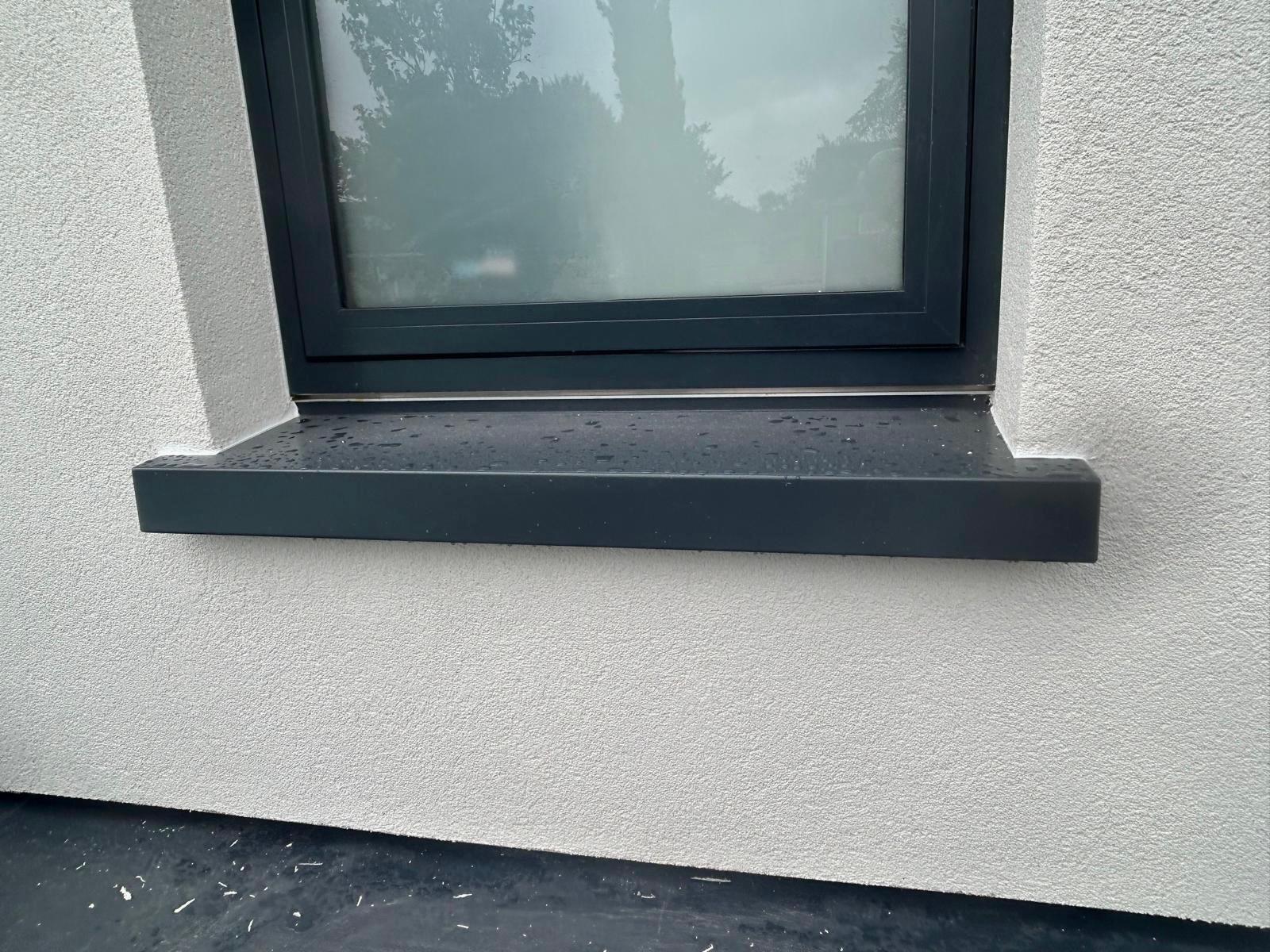
The vertical edge at the back of your cill is where it meets the window frame and insulation. This is the most critical junction on the entire project.
What you need:
An upstand height of 25-40mm for EWI projects. This gives enough surface area for the render system to lap onto. The reinforcement mesh from your insulation system should extend down over this upstand. A bead of silicone sealant goes underneath, between the mesh and the aluminium.
Why it matters:
If the upstand is too short, the render can't form a proper seal. Rainwater finds its way behind the cill. If the upstand is too tall, it looks wrong and can interfere with opening windows.
For Victorian and Georgian properties with deep reveals, check out our guide to bay window cills which covers the specific challenges of period buildings.
The Front Edge (Drip)
The drip is the bit that hangs over the wall and throws water clear. It's deceptively simple but often done wrong.
What you need:
A minimum 40mm projection past the finished render face. Not past the insulation. Past the render. Those extra 10-15mm of render thickness make a real difference.
Underneath the drip, there should be a groove or notch. This stops water from tracking back along the underside of the cill and running down the wall. Without this groove, water clings to the aluminium and ends up exactly where you don't want it.
Why it matters:
Water damage to EWI systems almost always starts at the cill junction. A cill that throws water clear is the single most important defence against render failure, algae growth, and long-term damage.
End Caps
The ends of your cill are open tubes. Water that lands on the cill will run along it and pour into these open ends if they're not sealed.
What you need:
Factory-fitted end caps. Not site-applied. Not silicone blobs. Proper folded and welded end caps fitted in our workshop before the cill leaves the building.
Why it matters:
We've seen hundreds of EWI failures that trace back to water getting in through open cill ends. The water runs behind the insulation, sits there for months, and slowly destroys the adhesive bond between insulation and wall. By the time you notice the problem, the damage is done.
End Returns
The end returns are the bits that wrap around the side of the window reveal. On an EWI project, these typically project 50mm into the reveal on each side.
What you need:
End returns that are long enough to cover the insulation on the reveal. If your reveal insulation is 30mm thick, your end return needs to be at least 30mm plus a bit extra for the render.
Why it matters:
Short end returns leave gaps. Gaps let water in. Water causes damage. It really is that simple.
How Different Insulation Types Affect Your Cill Choice
Not all external insulation is created equal. The insulation behind your cill affects how you should detail the junction.
Expanded Polystyrene (EPS)
EPS is the most common insulation type for Irish EWI projects. It's affordable, performs well, and has moderate breathability. According to the Irish Green Building Council, EPS accounts for roughly 70% of domestic EWI installations in Ireland.
Cill considerations for EPS:
Standard 40-50mm overhang works well. Make sure your sealant is compatible with EPS. Some solvent-based sealants literally dissolve polystyrene. Check with your EWI supplier for approved products.
EPS is reasonably forgiving if small amounts of water get behind the cill. It doesn't absorb water like a sponge. But it's not waterproof, and long-term moisture exposure will eventually cause problems.
Mineral Wool
Mineral wool is highly breathable. It's often specified for solid-walled buildings where maximum breathability is required. The Sustainable Energy Authority of Ireland (SEAI) accepts mineral wool systems for grant-funded retrofits of pre-1940 buildings.
Cill considerations for mineral wool:
Go bigger on the overhang. 50mm minimum. Mineral wool is vulnerable to water. When it gets wet, it loses insulating performance and takes a long time to dry out. Your cill needs to keep every drop of rain away from the insulation.
Sealing at the upstand is critical. Any gap, any failure point, any route for water to enter will cause problems. Consider under-cill flashing for exposed locations.
Wood Fibre
Wood fibre insulation is increasingly popular for high-end Irish retrofits. It's fully breathable, has excellent moisture buffering, and stores carbon rather than releasing it. Companies like Ecological Building Systems have been promoting wood fibre for heritage buildings.
Cill considerations for wood fibre:
Wood fibre can handle moisture better than mineral wool. It absorbs water, holds it, and releases it slowly without losing performance. But this doesn't mean you should let water in deliberately.
Specify maximum overhang projections. Use factory-fitted end caps. Seal everything properly. Wood fibre is forgiving, but prevention is still better than cure.
Irish Building Types and What They Need
Different building types have different requirements. Here's what we've learned from supplying cills across Ireland.
Georgian and Victorian Terraces (1750-1910)
These buildings have solid brick or stone walls with lime mortar. They were designed to breathe. Wrapping them in the wrong materials causes serious damage.
Typical wall thickness: 350-450mm solid brick, or 400-600mm random rubble stone
Breathability requirement: Very high. These buildings rely on vapour permeability to stay dry.
Recommended cill projection: 110-150mm depending on insulation thickness
Special considerations: Deep window reveals often mean complex cill shapes. Bay windows are common. See our bay window cill guide for these situations.
Georgian and Victorian buildings are often in Architectural Conservation Areas. Check with your local planning authority before making external changes.
1920s-1950s Semi-Detached (Post-Independence Housing)
The houses built in Ireland's first decades of independence typically have solid walls of mass concrete, hollow block, or brick. They're more consistent than period buildings but still need breathable solutions.
Typical wall thickness: 225-330mm solid or cavity
Breathability requirement: Medium to high. Many of these houses have solid walls without cavities.
Recommended cill projection: 100-130mm
Special considerations: These houses often have timber windows that are being replaced as part of the retrofit. Make sure your cill dimensions account for the new window position.
1960s-1980s Housing
These buildings introduced cavity wall construction to Ireland. They're generally easier to insulate externally because the walls are more consistent.
Typical wall thickness: 270-300mm with 50-100mm cavity
Breathability requirement: Medium. The outer leaf has some breathability, but it's less critical than with solid walls.
Recommended cill projection: 90-120mm
Special considerations: Some of these houses already have cavity insulation. If you're adding external insulation on top, make sure the system is compatible.
The SEAI Grant Connection
Most EWI projects in Ireland are funded through SEAI home energy grants. As of 2025, you can get up to €6,000 towards external wall insulation for detached houses, with higher amounts available under the Warmer Homes Scheme for eligible households.
What the grants require:
All materials and systems must be NSAI Agrément certified for use in Ireland. The National Standards Authority of Ireland (NSAI) maintains a register of approved EWI systems.
Your insulation installer must be registered with SEAI. The work must meet minimum performance standards. And crucially, all components must be detailed according to the certified system's requirements.
How this affects your cills:
When you're using an NSAI-certified EWI system, you need to match the certified details for window cill junctions. Deviating from these details can void the system warranty and potentially affect your grant eligibility.
Most certified systems specify requirements for cill projection, upstand height, and sealing methods. Our cills are designed to meet these requirements. If you're not sure what your system needs, ask your EWI installer or contact us for guidance.
Thermal Bridging: The Hidden Problem
Even if your cill is waterproof and your wall is breathing perfectly, there's another issue to consider: thermal bridging.
A thermal bridge is a path where heat escapes faster than through the surrounding structure. At window cills, thermal bridges typically occur where the aluminium cill sits directly on masonry without any insulation underneath.
The Passive House Institute has published extensive research on thermal bridging at window installations. Their conclusion: even small thermal bridges can significantly increase heat loss and cause local condensation.
Signs of thermal bridging at cills:
Condensation on the inside of the window reveal, near the cill. Black mould in the corners where the cill meets the wall. Cold spots that show up on thermal imaging. Higher heating bills than expected given the insulation level.
Solutions:
For high-performance retrofits, consider insulated cill supports. These sit between the masonry and the aluminium cill, providing a thermal break. Companies like Just Airtight supply these products in Ireland.
For standard retrofits, make sure the insulation continues as close to the window frame as possible. Don't leave gaps in the insulation layer at the cill level.
Sealants: Getting the Chemistry Right
The sealant you use at the cill junction is more important than most people realise. Wrong sealant choices cause more problems than wrong cill sizes.
Silicone sealants:
These are the standard choice for aluminium-to-render junctions. They stay flexible over time, bond well to both surfaces, and don't react with EPS or other common materials. Most EWI system suppliers specify silicone for cill sealing.
Look for products that meet ISO 11600 Class 25 for movement tolerance. Cills expand and contract with temperature changes. Your sealant needs to accommodate this movement without cracking.
Polyurethane sealants:
Some installers prefer polyurethane for its paintability and strong initial bond. However, check compatibility with your insulation type. Some polyurethane products contain solvents that attack EPS.
Hybrid sealants:
Modern hybrid sealants combine properties of silicone and polyurethane. They're increasingly popular for EWI work. Again, check with your system supplier.
What to avoid:
Acrylic sealants crack and fail in external applications. Oil-based products can stain renders. Cheap "builder's silicone" often lacks the flexibility needed for metal-to-masonry joints.
The Construction Products Association publishes guidance on sealant selection for construction applications.
The Measurement Mistake That Wastes Time and Money
Here's the single biggest mistake we see on EWI projects: measuring for cills before the insulation is complete.
It happens like this. The contractor wants to order cills early. They measure from the window frame to the existing wall. They add what they think the insulation depth will be. They order the cills. Then when the insulation goes on, it's thicker than expected. Or the reveals have extra insulation. Or the render is 15mm instead of 10mm.
Now the cills are too short. They don't project past the finished wall. Water runs off the cill edge and straight down onto the render. Within two winters, there's algae growth, staining, and early signs of failure.
The right approach:
Wait until the insulation boards are fixed. Measure from the window frame to the face of the insulation. Add the render thickness (ask your insulation contractor). Add your desired overhang. Now order your cills.
Yes, this means the cills arrive a week or two later. But they'll actually fit. And they'll protect your client's investment for decades rather than failing in the first few years.
Our Cills App walks you through this process step by step. You enter the insulation depth, the render thickness, and the overhang you want. The app calculates the total projection. No mental arithmetic. No mistakes.
Step-by-Step: Ordering Cills for Your EWI Project
Ready to order? Here's exactly what information you need:
Before You Measure
Confirm these details with your EWI contractor:
Insulation type and thickness (EPS 100mm? Mineral wool 120mm?)
Render system and thickness (typically 10-15mm)
Any specific cill requirements from the system certification
Whether reveals are being insulated, and if so, with what thickness
The Measurements You Need
For each window opening:
G (Overall Width): Measure between the reveal faces at cill level. For EWI projects with insulated reveals, this is measured after the reveal insulation is fitted.
B (Projection Depth): From the window frame to the finished render face, plus your desired overhang. For most EWI projects, this is 90-150mm.
A (Upstand Height): Typically 25-40mm for EWI work. This is the vertical edge at the back that the render laps onto.
DE (Drip Edge): How far the front edge extends beyond the projection. Standard is 40-50mm.
J (End Returns): How far the ends wrap into the reveals. Typically 50mm each side for EWI projects.
RAL Colour Selection
Most EWI projects use one of a few standard colours:
RAL 7016 (Anthracite Grey): The most popular choice, matches modern grey windows
RAL 9005 (Jet Black): For contemporary dark window frames
RAL 9010 (Pure White): For traditional white windows and period properties
RAL 7015 (Slate Grey): A softer alternative to anthracite
We can supply any RAL colour. If your architect has specified something specific, we can match it. Just give us the RAL code when ordering.
For help choosing colours, see our guide to RAL colour selection.
Factory Options
End caps: We strongly recommend factory-fitted end caps for all EWI projects. The small extra cost is worth it for the watertight seal.
Lengths: We can supply cills up to 3000mm in a single piece. For wider openings, we supply multi-piece cills with fabricated joints.
Special shapes: Bay windows, curved walls, and complex geometries are all possible. Contact us for these projects.
When Things Go Wrong: Common Failures and How to Avoid Them
Every failure we see teaches us something. Here are the most common problems and how to prevent them.
Algae and Green Staining
The symptom: Green or black growth on the render, concentrated below window cills.
The cause: Water dripping off short cills and running down the render face. The constant moisture promotes algae growth.
The solution: Cills that project far enough to throw water clear of the wall. Minimum 40mm past the finished render. More in exposed locations.
Render Cracking at Cill Edges
The symptom: Cracks in the render at the junction between cill and wall.
The cause: Movement between the aluminium cill and the render. Cills expand and contract with temperature. Render doesn't move as much. Without proper flexible sealing, the junction cracks.
The solution: Correct silicone sealant at the junction. The sealant acts as a flexible bridge between two materials that move differently.
Water Behind Insulation
The symptom: Damp patches on internal walls. Insulation boards becoming detached. Render bubbling or blistering.
The cause: Water entering behind the cill through gaps at the ends, or through failed seals at the upstand.
The solution: Factory-fitted end caps. Proper upstand height. Correct sealing sequence with approved sealants.
Cold Spots and Condensation
The symptom: Condensation on internal reveals near the cill. Mould growth in corners.
The cause: Thermal bridging where the cill sits on cold masonry without adequate insulation.
The solution: Insulated cill supports for high-performance projects. Continuous insulation at reveal level for standard projects.
Working With Heritage Buildings
Ireland has thousands of protected structures and buildings in Architectural Conservation Areas. These require extra care when adding external insulation.
The Department of Housing guidance on energy efficiency in traditional buildings recommends breathable insulation systems for pre-1940 buildings with solid walls.
Key considerations for heritage projects:
Lime-based renders are often required to maintain breathability. These are softer and more permeable than modern cement renders. Your cill detailing needs to work with lime render, which behaves differently to cement-based systems.
Window proportions matter. Heritage authorities may have views on cill proportions and how they relate to the original window design. Early consultation with your local conservation officer can prevent problems later.
Colour matching is critical. A bright white aluminium cill on a stone cottage looks wrong. We can match traditional colours and natural metal finishes for heritage projects.
The Cills App: Built for EWI Projects
We created the Cills App specifically because EWI projects have complex requirements that standard ordering systems don't handle well.
When you start a project in the app, you select "Retrofit with EWI" as the project type. The app then prompts you for:
Insulation type and thickness
Render system and thickness
Desired overhang
It calculates the required projection automatically. No mental arithmetic, no forgotten millimetres.
The app includes:
3D preview showing exactly what your cill will look like
Dimension validation to catch mistakes before ordering
RAL colour picker with visual previews
Instant pricing so you know costs before committing
Order tracking from fabrication to delivery
📱 Download the app: iOS | Android
💻 Or use our web platform: app.cills.ie
Further Reading and Resources
Irish Resources
SEAI Home Energy Grants - Current grant rates and eligibility
NSAI Agrément Certification - Certified EWI systems for Ireland
Heritage Council - Guidance on traditional buildings
Irish Green Building Council - Sustainable construction resources
Technical Standards
ETAG 004 - European standard for ETICS
EN ISO 10211 - Thermal bridge calculations
BS 8215 - Code of practice for design and installation of damp-proof courses
Industry Bodies
Construction Industry Federation Ireland - Irish construction industry resources
Passive House Institute - High-performance building standards
Building Research Establishment - Building science research
Get Your Cills Right First Time
External insulation represents a major investment in your building's future. The difference between a system that lasts 30 years and one that fails in 5 often comes down to details. Cill details.
The cills we supply are:
1.5mm marine-grade aluminium that won't corrode in Irish weather
Polyester powder coated with 30+ year colour stability
Made to measure for exact fit
Factory-finished with optional end caps
Combined with correct measurement, proper installation, and approved sealants, they'll protect your EWI investment for decades.
Ready to order? Use our mobile app to spec your cills, or contact us to discuss your project.
Performance
The Hidden Reason Your External Insulation Fails at Window Openings
Why aluminium cills fail on breathable external insulation systems. A practical guide for Irish EWI contractors and homeowners.

Trusted & Used By Professionals From






Order Your First Custom Aluminium Product
Cills.ie makes it easy to measure, customise, and order aluminium cills, flashings, trims, and cappings & more. All online, with engineer support included.